
Aniket Pawar
Deduct up to $2,560,000 in 2026 under Section 179 on new and used CNC and fabrication machinery. See what qualifies and the December 31 deadline.

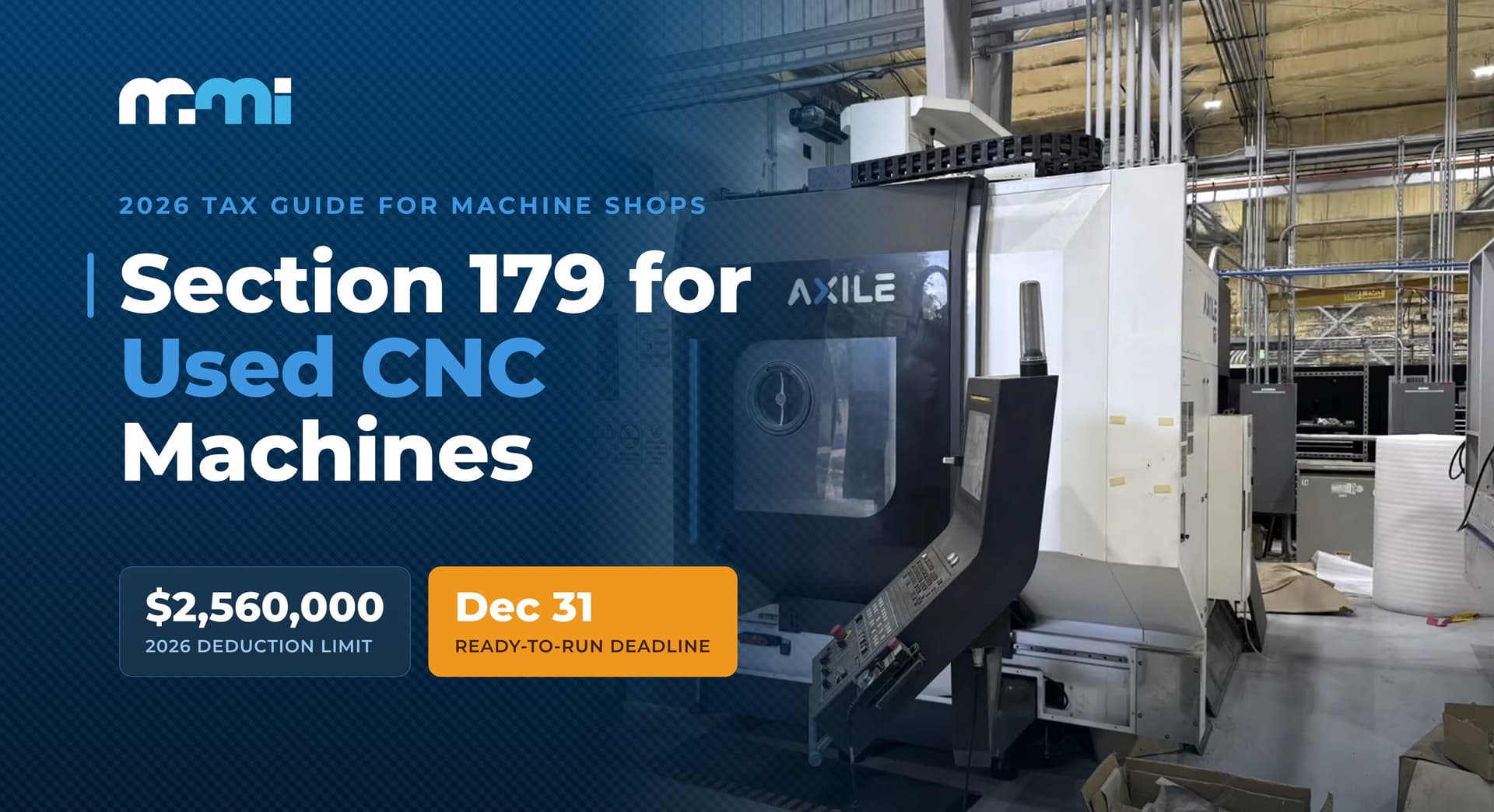
Deduct up to $2,560,000 in 2026 under Section 179 on new and used CNC and fabrication machinery. See what qualifies and the December 31 deadline.
Nov 4, 2026
Section 179 lets business owners take a tax deduction on qualifying CNC machinery in the year of purchase. For example, if a business owner purchases a CNC machine costing $50,000, they can deduct the entire amount from their taxable income in that year, resulting in significant tax savings compared to spreading the depreciation over several years.
For machine shops, this can lower taxable income fast and improve year-end tax savings.
New and used CNC machinery qualifies if the machine is placed in service for business use.
Financed equipment can still qualify, which helps protect cash flow.
Bonus depreciation adds more tax savings after Section 179.
MMI buyers can use these rules to reduce the real cost of machinery equipment.
If you run a machine shop or small manufacturing business, Section 179 can make a big difference when you buy machinery equipment. This part of the tax code allows a first-year tax deduction on qualifying purchases instead of spreading depreciation over several years. That means stronger tax savings now, not later. For many shops buying a CNC machine, fiber laser, press brake, or similar capital equipment from MMI, Section 179 can lower the effective cost and free up money for operations.
Section 179 applies directly to many machinery purchases used in manufacturing. Instead of writing off a CNC machine over its useful life, eligible business owners can deduct all or part of the purchase price in the tax year the equipment is placed in service.
That matters when you are investing in production. A qualifying machine from MMI can create an immediate deduction tied to the machine’s cost, which may reduce your tax bill now. The next sections break down why this tax incentive matters so much to machine tool businesses.
Section 179 is an IRS tax code provision that lets eligible businesses expense qualifying equipment in the current year rather than depreciating it over time. For machine tool businesses, that can include machinery equipment used for business purposes, such as CNC machines, fabrication systems, and related production assets.
Here is why that matters. Manufacturing equipment is expensive, and standard depreciation often spreads the write-off across years. Section 179 changes that timing. If your shop buys a qualifying machine and places it in service before the end of your tax year, you may claim a much larger first-year deduction.
For small business manufacturers, this tax incentive can improve buying power. It supports growth, helps preserve operating cash, and turns a capital equipment purchase into faster tax benefits. If you are planning equipment expansion through MMI, Section 179 can be part of a smarter purchasing strategy.
CNC machines are depreciating assets, which means their cost is usually recovered over time. Under older depreciation treatment, a machine shop would write off a machine gradually. Section 179 allows a different path by moving much of that tax deduction into the first year.
Take a simple example:
A shop buys a $700,000 CNC machine and qualifies for Section 179 benefits.
Section 179 can allow a $700,000 deduction in the year of purchase instead of smaller annual deductions.
This can sharply reduce the tax bill for the current year and change the real after-tax cost of the machine.
This is why Section 179 remains one of the strongest business tax deductions for equipment-heavy manufacturers. When shops source CNC machines through MMI, they are not just adding production capacity. They can also be creating immediate tax benefits that support cash flow and future investment.
Section 179 follows the date a machine is placed in service, not the date you order it or pay the invoice. For a calendar-year shop, these four steps get a machine onto the 2026 return.
1. Buy the machine before December 31
Sign the purchase or finance agreement early enough to leave room for shipping. The purchase date alone doesn't decide the tax year, but nothing below can happen without it. A shop on a fiscal year works to its own year-end date instead.
2. Get it delivered to your facility by December 31
Freight carriers and rigging crews book up fast in December, so lock in a delivery date when you approve the quote. MMI coordinates delivery to shops nationwide.
3. Have it ready to run by December 31
The machine doesn't need to be cutting parts by December 31. It does need to be ready and available for use. A machine that arrives ready to run counts in the year it's delivered, even if the first job doesn't start until January. A machine that still needs rigging or a power drop counts in the year that work is finished, according to IRS Publication 946. Plan the install date along with the delivery date.
4. Talk to an MMI machine specialist
The calendar is the hard part. Contact MMI at (312) 226-4150 to find a machine that can ship in time and set up financing before year-end.
For manufacturers, the most important point is simple: many forms of CNC machinery and fabrication equipment are treated as qualifying tangible property. If your shop buys equipment for active production, that purchase may support valuable business tax deductions in the year the machine is placed in service.
Common eligible equipment purchases can include:
CNC machines used in metalworking and production.
Fiber lasers used for cutting operations.
Press brakes used in fabrication workflows.
Other machinery equipment purchased for shop production.
Certain office equipment or software may qualify, but machinery is the main focus for most shops.
This matters when you are building capacity through MMI. A machine tool business buying equipment to improve throughput, shorten lead times, or add services may also gain first-year tax relief. That makes Section 179 especially useful for growing manufacturers that rely on production assets every day.
Yes, used equipment can qualify for Section 179. The key rule is that the machinery must be new to your business, even if another owner used it before. That opens the door for many machine shops that want solid production capability without paying new-equipment pricing.
This is a major tax incentive for business owners comparing machine options. If your shop buys a used CNC machine, laser, or fabrication asset and places it in service in the same tax year, the full purchase price may still be eligible for deduction, subject to the usual limits and business income rules.
For smaller manufacturers, that can mean practical tax relief without changing the buying plan. A used machine from MMI may help you control acquisition cost, add output, and still create strong first-year savings. The next step is understanding the annual limits tied to these deductions.
Section 179 is generous, but it still has annual limits. For 2026, the maximum deduction is $2,560,000, and the benefit begins to phase out when total qualifying equipment purchases exceed $4,090,000. That keeps the rule especially relevant for small and midsize manufacturers.
There is also a business income test. Your deduction is tied to business income, and your tax rate affects the value of your savings. For machine shops planning major machinery investments through MMI, understanding these numbers is essential before filing a tax return.
For 2026, the tax code sets clear Section 179 limits. Eligible businesses can deduct up to $2,560,000 of qualifying property placed in service during the tax year. The deduction then starts shrinking once total qualifying purchases go above $4,090,000.
Here is a simple text table for planning:
| 2026 Section 179 Item | Amount |
|---|---|
| Maximum deduction | $2,560,000 |
| Phase-out threshold begins | $4,090,000 |
| Fully phased out | $6,650,000 |
| Bonus depreciation | 100% for eligible property under current guidance |
For machine shops, these deduction limits matter most when buying multiple machines or a full production line. If you are acquiring CNC machinery from MMI, the full cost of one or several machines may fit comfortably inside these thresholds, helping you capture meaningful first-year savings.
Even if machinery qualifies, there are still rules. Section 179 is limited by business income, which means the deduction cannot exceed the taxable income limitation from the active conduct of a trade or business. If your shop has a lighter-profit year, that affects how much you can use now.
The equipment also has to be placed in service during the tax year. Ordering a machine is not enough. It must be delivered, installed, and ready for use by the end of your tax year. This is a key issue for machine buyers working around production schedules and lead times.
Eligible businesses include common structures such as corporations, LLCs, partnerships, and sole proprietorships. The equipment must be used more than 50% for business. For MMI buyers, timing delivery and installation before year-end is often just as important as negotiating the machine itself.
The basic calculation starts with the machine’s purchase price, then checks the annual limit, the phase-out rules, and your business income. From there, you can estimate how much Section 179 deduction may be available before your tax return is prepared.
For many machine shops, the easiest savings estimate uses a simple formula: machine cost multiplied by tax rate. That gives a rough picture of what the deduction may save. The examples below show how a CNC purchase from MMI can translate into real tax results.
Let’s use a practical machine shop example. Say you buy a CNC machine from MMI for $700,000 and place it in service this year. If the machine qualifies and your shop can claim the full purchase price, your Section 179 deduction may be $700,000.
Now estimate tax impact with a simple calculation:
| Item | Amount |
|---|---|
| Machine purchase price | $700,000 |
| Estimated Section 179 deduction | $700,000 |
| Example tax rate | 35% |
| Estimated tax savings | $245,000 |
| Net after-tax machine cost | $455,000 |
That example shows why this deduction matters. The write-off lowers taxable income, which can reduce the tax bill by $245,000 at a 35% rate. For many manufacturers, that turns a major capital decision into a more manageable investment and supports better year-one cash planning.
Yes, Section 179 and bonus depreciation can work together. A business may use Section 179 first and then apply bonus depreciation to any remaining eligible basis. This can increase the first year write-off on machinery equipment.
That pairing can be powerful for machine shops making large purchases. If the full purchase price of all equipment is not fully covered by Section 179 alone, bonus depreciation may further reduce the tax bill. This becomes especially useful when buying multiple machines from MMI in one year.
These two rules both help with first-year write-offs, but they do not work the same way. Section 179 is an election with annual limits and a taxable income restriction. Bonus depreciation is broader in some cases and can apply after the Section 179 amount is used.
Key differences include:
Section 179 has a dollar cap; bonus depreciation does not have the same annual dollar limit.
Section 179 is limited by taxable business income; bonus depreciation can go beyond that.
Section 179 gives more control over which assets you expense in the year of purchase.
Bonus depreciation can apply to remaining eligible basis after Section 179.
For manufacturers, the big difference is planning flexibility. A shop buying CNC machinery, fabrication systems, or several machine tools from MMI may use both rules as part of a larger tax incentive strategy, especially when year-end expansion is underway.
Most shops know Section 179 lets them write off equipment. Fewer know the details that decide how big the deduction is and which tax year it lands in.
1. Delivery counts when the machine arrives ready to run
The deduction follows the date the machine is placed in service, which the IRS defines as ready and available for a specific use. A machine that arrives on December 20 ready to run counts for this year, even if the first part doesn't come off until January. A 5-axis machining center that still needs rigging or a power drop counts in the year that work is finished. IRS Publication 946 uses this exact case: a machine delivered one year but not installed and operational until the next is placed in service the next year.
2. Little or no money down still qualifies
The deduction is based on the machine's cost, not the cash you put down. Finance a press brake with nothing down, place it in service before year-end, and the full purchase price can qualify for Section 179. The usual limits still apply: the annual cap and your business income for the year.
3. Trade-ins need a CPA's review
Since 2018, equipment trades no longer get like-kind exchange treatment, so a trade-in is generally handled as a sale of your old machine. Any gain on that sale is taxable, and gain on a machine you already wrote off is taxed as ordinary income. IRS Publication 946 still says that when you buy with cash and a trade-in, the cost for Section 179 includes only the cash you paid. Ask your CPA how your trade-in will be treated before you file, and keep an invoice that shows the machine price and the trade-in credit as separate lines. Selling the old machine outright through MMI is another option to review with them.
4. Used machines count the same as new
The machine has to be new to your business, not new from the builder. A 2013 machine you've never owned qualifies the same way a machine off the factory floor does. That makes used machines from MMI a strong fit for Section 179: a lower purchase price, with all of it eligible for the deduction.
5. The 2026 cap is $2,560,000
For tax years beginning in 2026, you can expense up to $2,560,000 of qualifying equipment. The cap shrinks dollar for dollar once total equipment placed in service passes $4,090,000. If you've seen $1.2 million quoted, that was the 2024 limit.
6. You choose how much to expense
Section 179 is an election, made machine by machine. You can expense all of a machine's cost, part of it or none, and depreciate whatever you don't expense. Most production machinery depreciates over 7 years. One catch: 100% bonus depreciation applies automatically to the remaining cost unless you elect out for that class of property, so spreading deductions over several years takes both choices. Your CPA makes both elections on Form 4562.
7. The 2026 limit has more than doubled since 2024
The cap rose from $2,500,000 in 2025 to $2,560,000 in 2026, and the phase-out threshold rose from $4,000,000 to $4,090,000. Both are inflation adjustments. The big jump came in 2025, when the One Big Beautiful Bill Act doubled the cap from $1,250,000 to $2,500,000.
Many problems with Section 179 come down to timing, records, or assumptions. Machine shops often focus on the equipment deal but forget that the tax deduction depends on exact rules. A mistake on your tax return can delay or reduce the benefit.
Watch out for these issues:
Assuming ordered equipment counts if it is not placed in service in the year of purchase.
Claiming machinery that is not used enough for business purposes.
Treating a fair market value lease like ownership.
Forgetting to keep purchase, financing, and installation records.
A smart move is to review the machine transaction with a tax advisor before year-end. That is especially important for MMI buyers coordinating delivery, setup, and financing. Good planning helps protect the deduction and keeps the savings tied to the machine where they belong.
Start with timing. If you want Section 179 benefits, the CNC machine must be placed in service before the end of your tax year. For MMI buyers, that means planning the quote, financing, delivery, and installation schedule early enough to avoid missing the deadline.
Next, look at structure. Since financed equipment can still qualify, business owners do not always need to pay the full purchase price upfront to access tax savings. That can help preserve cash flow while still bringing in revenue-producing capital equipment for the shop floor.
Finally, match the machine purchase to your expected income. A CNC lathe, machining center, fiber laser, or press brake from MMI may create strong savings when your shop has taxable income to offset. When the machine adds capacity and lowers taxes at the same time, the investment becomes far easier to justify.
Understanding and utilizing Section 179 can significantly enhance the financial health of machine shops and manufacturers. By knowing which CNC and fabrication equipment qualifies for these tax deductions, businesses can make informed decisions that translate into substantial savings. This not only eases the burden of procurement costs but also encourages investment in better machinery, ultimately improving productivity and efficiency. Don’t miss out on these opportunities to leverage tax benefits for your business. If you have questions or need guidance on how to maximize your Section 179 savings when purchasing CNC machines, get in touch with us today!
Yes, many small businesses can use Section 179 very effectively for machinery purchases. The main limits are the maximum deduction and business income. If business owners have enough income and the machine is placed in service on time, the tax benefits can be substantial.
Yes. Equipment financing can still support Section 179 because eligibility is tied to ownership and placed-in-service timing, not just cash payment. But a true fair market value lease usually does not qualify. For business tax deductions, the machine must be owned for tax purposes in the year of purchase.
Machine shops can review the IRS tax code under Section 179 of the Internal Revenue Code, along with IRS Publication 946 and Form 4562 instructions. Those sources provide general information on eligibility, limits, and reporting on a tax return, though a tax professional should confirm your situation.

Deduct up to $2,560,000 in 2026 under Section 179 on new and used CNC and fabrication machinery. See what qualifies and the December 31 deadline.


Get the latest industry insights and machinery tips delivered to your inbox.
Access a global network of verified industrial equipment, get expert guidance, and close deals faster with MMI Direct’s full-service platform. From sourcing to logistics, we handle it all.


Copyright © 2026 MMI. All rights reserved.


