
Aniket Pawar
A Swiss lathe feeds bar through a guide bushing so long, thin parts hold tolerance. When one beats a conventional lathe, and what to check used.

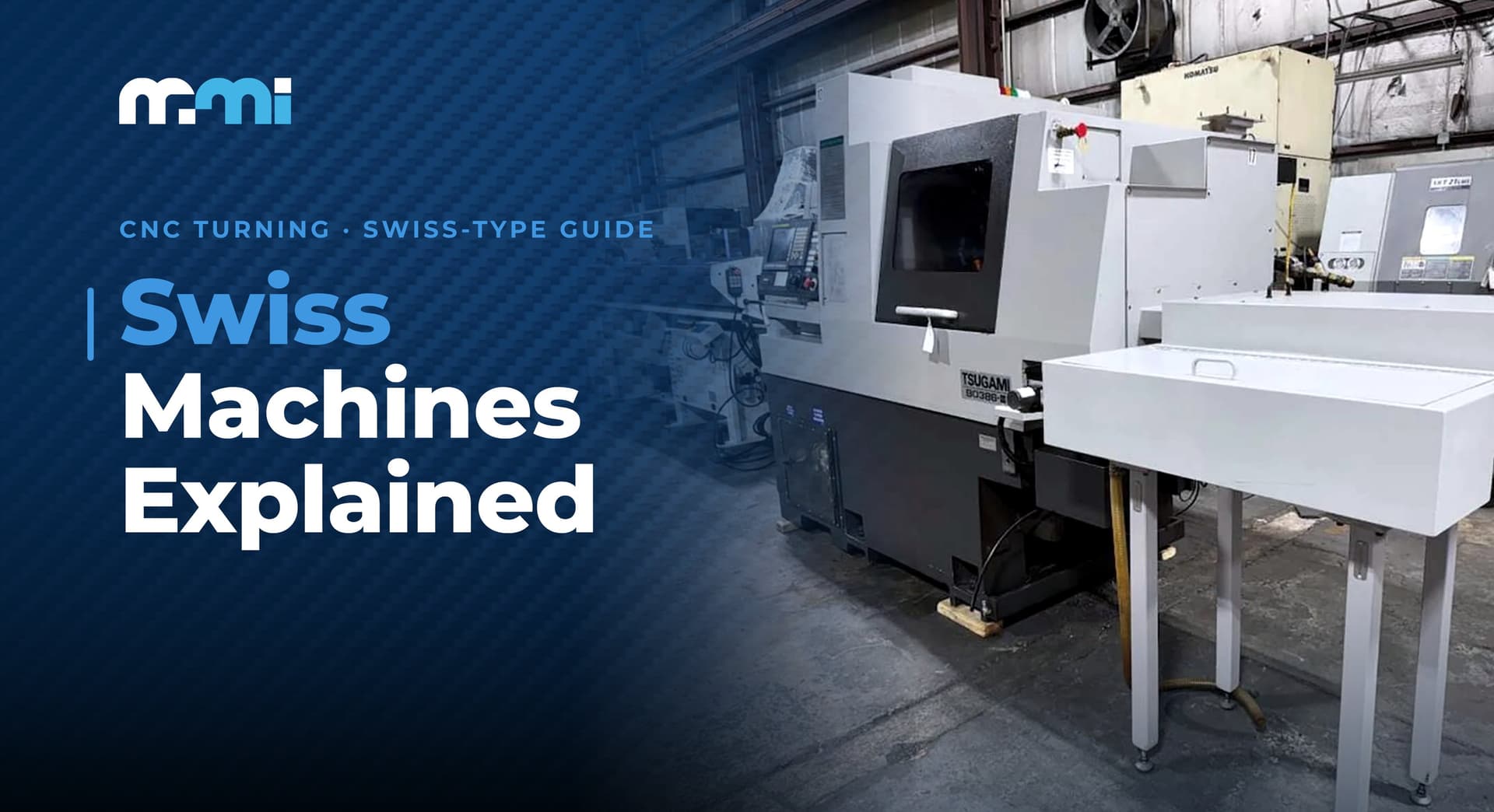
A Swiss lathe feeds bar through a guide bushing so long, thin parts hold tolerance. When one beats a conventional lathe, and what to check used.
Nov 23, 2026
A Swiss machine, also called a Swiss-type lathe or Swiss screw machine, is a CNC lathe built for small, precise turned parts. It holds the bar stock in a guide bushing right next to the cutting tool and moves the bar itself in and out along the Z axis. Because the tool always cuts close to that support, a Swiss machine can turn long, thin parts to tight tolerances that would bend or chatter on a conventional lathe.
Swiss machines run medical screws and implants, connector pins, hydraulic fittings, firearm components, aerospace fasteners and electronics parts. Most top out at 20 to 32 mm bar capacity, and some reach 38 mm or more.
On a conventional CNC lathe, the bar is clamped in a chuck that stays put, and the tool travels along the part. The farther the tool moves from the chuck, the more the part can flex.
A Swiss machine turns that around. Its sliding headstock grips the bar and pushes it through a guide bushing, a precision sleeve that supports the rotating bar. The tools stay at the face of the bushing. As the headstock feeds the bar forward, each new length of material reaches the tool already supported a few millimeters away. The cut section stays short and stiff the whole time, no matter how long the finished part is.
That one change drives the rest:
| Feature | Swiss-type lathe | Conventional CNC lathe |
|---|---|---|
| How the bar moves | Headstock slides; bar feeds through a guide bushing past fixed tools | Bar held still in the chuck; tools travel along it |
| Best part shape | Small diameter, long and slender | Larger diameter, short and rigid |
| Typical bar capacity | 20 to 32 mm, some to 38 mm | Much larger, depending on chuck size |
| Controlled axes | 7 to 13 typical | 2 to 5 typical |
| Finished in one setup | Turning, milling, cross drilling, threading, cutoff and back work | Often needs a second operation for back work |
| Bar stock | Centerless-ground bar with tight diameter tolerance for guide-bushing work | Standard bar |
| Best run size | Medium to high volume of the same part | Job-shop work, short runs and frequent changeovers |
The design dates to the 1870s, when Swiss watchmakers needed large volumes of tiny, accurate parts that the fixed-head lathes of the day could not hold. Cam-driven Swiss automatics made watch parts for about a century. Tornos showed one of the first numerically controlled sliding-headstock lathes, the Elector 16, in 1978, and CNC Swiss machines have since moved well beyond watches.
A Swiss machine earns its place when several of these are true at once. One alone rarely justifies it.
The parts are long relative to their diameter. A common rule of thumb puts the Swiss threshold at a length-to-diameter ratio of 4 to 1 or more. Below that, a conventional lathe or turn-mill can usually make the part economically. Above it, the guide bushing's support starts to pay for itself in accuracy and finish.
The parts are small. If the bar fits inside a 20 to 32 mm machine, a Swiss is an option. Parts that fit in the palm of your hand, with features measured in thousandths, are its core work.
Tolerances are tight. Holding the bar close to the cut limits deflection and vibration, which helps with concentricity, roundness and surface finish. Medical, aerospace and electronics parts often need tolerances that a conventional lathe struggles to repeat on long, thin work.
The part has features on several sides. A Swiss machine with live tools and a sub-spindle can turn, mill flats, cross drill, thread and back-work the part, then cut it off finished. Every second operation you remove saves handling time and removes a source of error.
You run the same part in volume. Swiss machines are at their best on runs of thousands to tens of thousands of identical parts, often running unattended with a bar feeder. Several tools can cut at once, so cycle times on complex small parts can be far shorter than on a conventional lathe.
A conventional CNC lathe is usually the better buy when parts are larger in diameter, short and rigid, or when the shop runs many different jobs in small quantities. Swiss machines take longer to set up, need more tooling, and are harder to program. They also need centerless-ground bar for guide-bushing work, and each bar leaves a remnant that becomes scrap. For a job shop with constant changeovers, those costs can outweigh the cycle-time savings.
The used CNC lathe market is deep enough that a shop can often add turning capacity faster and with less risk than it can add a Swiss. Shops that already run Swiss work, or have a steady contract for small precision parts, get the most from adding a used Swiss machine.
The options on a Swiss machine decide what it can make. When you compare used machines, these matter as much as the brand and year.
Bar feeder. A Swiss machine runs from bar, and a bar feeder loads new bars automatically so the machine keeps cutting without an operator. For production work and lights-out running, treat it as essential. Check that the feeder matches the machine's bar capacity and that it comes with the machine. A Swiss sold without its bar feeder is worth less to most buyers.
Sub-spindle. The sub-spindle takes the part from the main spindle in a synchronized handoff and machines the back side while the main spindle starts the next part. Without one, back-side features need a second operation. Most production Swiss work assumes a sub-spindle.
Live tooling. Driven tools let the machine mill, drill off center and cross drill without moving the part to a mill. Count the live tool positions on both the main and sub side, and check that the tool holders come with the machine.
Guide bushing type. A rotary guide bushing that turns with the bar handles higher speeds and causes less wear on the bar surface than a fixed bushing. Some machines can also run without a guide bushing. In that mode they take larger bar or unground stock, leave a much shorter remnant, and suit shorter parts. A convertible machine gives a shop more range.
Axes and tool count. More axes and more tools mean more operations can run at the same time. A 7-axis machine and a 12-axis machine of the same bar size are built for very different work.
Coolant and fire safety. Many Swiss machines run on cutting oil instead of water-based coolant, so check for a fire suppression system and an oil mist collector. High-pressure coolant helps with deep drilling and chip control.
Most Swiss machines on the US used market come from a handful of builders in Japan, Switzerland, Germany and South Korea. MMI buys and sells used Swiss lathes from all of them. The table shows the series and models that come through most often.
| Builder | Based in | Series and models | Known for |
|---|---|---|---|
| Citizen | Japan | Cincom L20, Cincom L32 (L series); Cincom M32 (M series) | One of the most widely installed Swiss platforms, with bar capacities from 12 to 32 mm |
| Star | Japan | SR-20, SR-32 (SR series) | High-volume precision production, backed by a large US service network |
| Tsugami | Japan | B0126-V, B0326-II, B0385 and BO386 (B series); SS20, SS207 5AX, SS327-III-5AX (SS series) | Medical and aerospace work, with a wide range of axis configurations |
| Tornos | Switzerland | Deco 10, 13, 20 and 26; EvoDeco 10, 16, 20 and 32 | Built in Moutier, the builder most tied to Swiss machining's origins |
| Nomura | Japan | NN-20J, NN-32YB | Compact production machines in the 20 and 32 mm classes |
| Traub | Germany | TNL-18, TNL-26, TNL-32 | Production sliding-headstock turning |
| Hanwha | South Korea | XD series | A newer entrant in US shops |
MMI also carries Swiss machines from KSI and Gen Turn, including the KSI TCM32 and the Gen Turn 36CS.
Brand matters on a used Swiss mainly for two reasons. The first is service and parts: a brand with a US service network and parts on the shelf keeps a 10-year-old machine running. The second is the buyer pool when you sell. Machines from the most widely installed brands have more operators and programmers who already know them.
MMI quotes every Swiss machine individually instead of publishing prices. These are the factors that move the number most:
For a figure on a specific machine, request a quote on any listing. If you own a Swiss lathe, a machine valuation gives you a number to work from, and the sell machinery page covers how MMI buys.
MMI handles Swiss machines from every major builder, from 20 mm Citizen and Star production machines to multi-axis Tsugami SS and Tornos EvoDeco models. Each listing notes the bar capacity, axis count, sub-spindle and live tooling, so you can compare configurations side by side. When the model or bar size you need isn't listed, MMI's team sources it through its network of shops and dealers.
Browse used Swiss lathes for current stock, or contact MMI with your part diameter and the operations the part needs.
What is a Swiss machine? A Swiss machine is a CNC lathe with a sliding headstock that feeds bar stock through a guide bushing past stationary tools. It is built for small, precise parts, especially long, thin ones.
Why is it called a Swiss machine? The design came from Switzerland's watch industry in the 1870s, which needed large volumes of tiny, accurate parts.
What is the difference between a Swiss lathe and a CNC lathe? On a conventional CNC lathe the bar stays fixed in the chuck and the tool moves along it. On a Swiss lathe the bar moves through a guide bushing and the tool cuts right next to that support, so long, thin parts do not flex.
When should you use a Swiss machine? When parts are small, long relative to their diameter (often 4 to 1 or more), need tight tolerances, have features on several sides, and run in volume.
What bar size can a Swiss lathe handle? Most Swiss-type lathes top out at 20 to 32 mm bar capacity, and some reach 38 mm or more.
Do you need a bar feeder on a Swiss machine? For production work, yes. A bar feeder keeps the machine loaded with new bars so it can run unattended.
What does a guide bushing do? It supports the rotating bar a few millimeters from the cutting tool, which limits deflection and chatter on long, slender parts

A Swiss lathe feeds bar through a guide bushing so long, thin parts hold tolerance. When one beats a conventional lathe, and what to check used.


Get the latest industry insights and machinery tips delivered to your inbox.
Access a global network of verified industrial equipment, get expert guidance, and close deals faster with MMI Direct’s full-service platform. From sourcing to logistics, we handle it all.



Copyright © 2026 MMI. All rights reserved.


